Sentinel InsightsWhat is generative engine optimization,and where does PR fit?
Generative engine optimization (GEO) gets your brand cited in ChatGPT, Gemini and AI Overviews. Learn how AI picks sources, GEO vs SEO, and where PR fits.
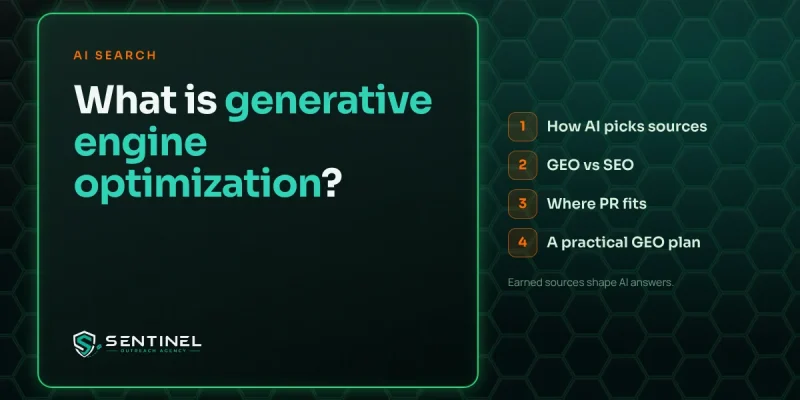
What is generative engine optimization?
Generative engine optimization (GEO) is the work of getting your brand named and cited in answers written by AI assistants: ChatGPT, Gemini, Perplexity, Claude and Google’s AI Overviews. Where traditional SEO aims for a ranked link, GEO aims for a mention inside the answer itself.
The shift matters because many buyers now ask an assistant before they ever see a list of links. If the assistant names three companies and yours isn’t one of them, you’ve lost the shortlist before the search began.
How AI assistants choose their sources
When an assistant answers a question that needs current information, it searches the web, reads a set of pages and writes a summary, often with citations. The pages it trusts most shape the answer.
Muck Rack’s research on more than 25 million cited links found that earned media made up 84% of AI citations in May 2026, a share that has held between 82% and 89% since mid-2025. Journalism alone accounted for 27%. Paid and advertorial content made up just 0.3%.
Put simply, assistants mostly repeat what credible third parties have already said about you.
GEO vs SEO
| SEO | GEO | |
|---|---|---|
| Goal | A high-ranking link to your page | Your brand named and cited in the answer |
| Main lever | Your own pages and the links pointing to them | What credible third parties say about you |
| Where success shows | Search results pages | ChatGPT, Gemini, Perplexity, AI Overviews |
| How it’s measured | Rankings, clicks, organic traffic | Mentions, citations, share of answer |
| Who usually does it | SEO teams | PR and SEO together |
The two overlap. Clear, well-structured pages still help assistants understand you. But the biggest lever in GEO sits outside your website.
Where PR fits
If assistants build answers from earned coverage, then earning coverage in the sources they cite is the most direct way to appear. That makes Digital PR the core of a GEO programme, not an add-on.
It also explains why buying sponsored articles is a weak GEO tactic. They can still help with reach and credibility, but they make up a tiny fraction of what assistants cite. The PR industry has noticed: as PRSA put it in October 2026, AI citations have created a renaissance moment for communications teams.
A practical GEO plan
- Audit. List the questions your buyers ask and run them through the main assistants. Record who gets named and which sources are cited.
- Map the sources. Note the publications, review sites and directories that appear again and again in your category.
- Earn coverage there. Pitch stories, data and expert commentary to those specific sources.
- Clean up your facts. Make sure your company description, services and leadership are consistent across your site, profiles and databases.
- Track monthly. Re-run the same questions and measure mentions, citations and share of answer against named competitors.
What you can’t control
No one controls what an AI assistant says, and anyone who promises a guaranteed mention is overselling. Models change, sources shift and answers vary by phrasing. GEO improves your odds by putting accurate, credible information where assistants look. Treat it as a long-term reputation effort, not a switch.
If you want to see where you stand today, our AI Visibility Audit runs this exact process for 50 buyer questions.
Questions readers ask
What does GEO stand for?
Generative engine optimization: earning mentions and citations in answers written by AI assistants.
Is GEO replacing SEO?
No. SEO still drives search traffic and helps assistants understand your pages. GEO adds a second goal: being named in AI answers.
Can I pay to appear in ChatGPT answers?
Not through organic answers. Paid and advertorial content makes up 0.3% of AI citations in Muck Rack's data.
How long does GEO take?
Fixing inconsistent company facts can show within weeks. Gains from new coverage usually take two to four months.
Find out what AI says about your brand.
Our AI Visibility Audit tests 50 buyer questions across four assistants.