
Sentinel InsightsHow to track brand mentionsin AI assistants.
How to track brand mentions in AI assistants like ChatGPT, Gemini and Perplexity: the questions to test, the fields to log and the numbers worth reporting.
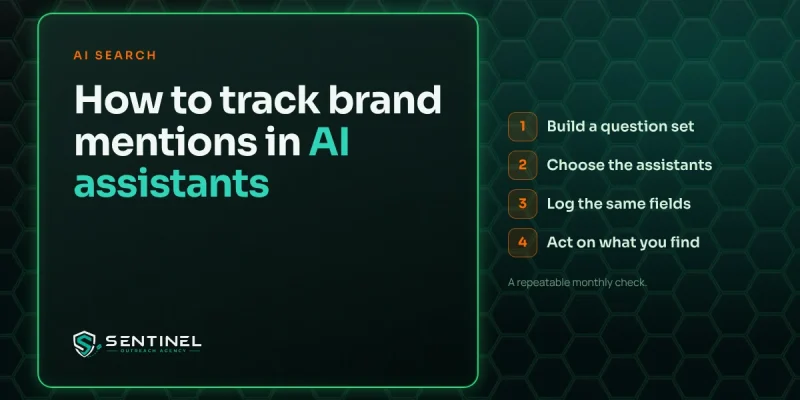
To track brand mentions in AI assistants, you need three things: a fixed set of buyer questions, a routine for running them through each assistant, and a log that records what every answer says about you. Google Alerts and social listening tools won’t catch these mentions, because an AI answer is written fresh for each person and never published anywhere.
The good news is that you can start by hand in an afternoon. Software helps once the question set grows, but the method matters more than the tool. Below is the process we use, step by step.
Why AI mentions need their own tracking
Traditional brand monitoring looks for your name on pages that exist: articles, posts, reviews. AI answers don’t sit on a page. They’re generated on demand, and two people asking the same question can get different answers.
That changes what you measure. Instead of counting articles, you’re sampling answers and asking two things: how often you appear when a buyer asks about your category, and whether what the assistant says about you is right.
It matters because the sources behind those answers are mostly other people’s coverage. Muck Rack’s Generative Pulse report from May 2026 analysed more than 25 million links cited by AI assistants and found that earned media made up 84% of them. Tracking shows you which of those sources mention you and which mention your competitors instead.
It also helps to separate mentions from citations. A mention is your brand named in the answer text. A citation is a linked source the assistant shows alongside its answer, which may or may not be your own site. You want both, and they move for different reasons: mentions follow what sources say about you, while citations follow which pages the assistant trusts for that question.
Step 1: build a question set
Your question set is the foundation of everything else. Change it often and your numbers stop meaning anything. A good set mixes four kinds of question:
- Category questions: “What are the best payroll tools for a small agency?” or “Which PR agencies work with SaaS startups?”
- Problem questions: the pain your product solves, phrased the way a buyer would say it out loud.
- Comparison questions: your brand against each main competitor, by name.
- Brand questions: what your company does, what it costs and what people say about it, asked using your own name.
Aim for 30 to 50 questions to start. Pull the wording from sales calls, support tickets and the search terms people already use to find you. Write each question down exactly and keep the wording fixed from month to month.
Step 2: choose the assistants to track
Track the assistants your buyers actually use. For most US brands that means ChatGPT, Google’s AI Overviews and AI Mode, Gemini, Perplexity and Microsoft Copilot. Add Claude or others if your audience uses them.
Test in a clean state each time: logged out where you can, or in a fresh session with memory and personalisation switched off. Note whether web search was on for each answer, because answers built from live search behave differently from answers built only from training data. Location can change results too, so test from the market you sell into.
Step 3: record the same fields every time
A spreadsheet works fine at first. For each question, assistant and run, record these fields:
| Field | What to record | Why it matters |
|---|---|---|
| Mentioned | Yes or no | The base of your mention rate |
| Position | Named first, in a list, or only in passing | Being named first carries more weight than a footnote |
| Accuracy | Correct, partly wrong or wrong | Wrong facts point to a source or company data problem |
| Sentiment | Positive, neutral or negative | Shows how the assistant frames you |
| Competitors named | Every other brand in the answer | Lets you work out share of answer |
| Sources cited | Each linked page | Shows where to earn coverage next |
Answers vary from run to run, so run your most important questions three to five times per assistant and log each result. A brand that appears in four of five runs is in a very different position from one that turned up once by chance.
Save the full text of each answer as well as your scoring. When a number moves, you’ll want to read what the assistant actually said.
Step 4: turn the log into a few clear numbers
A long log is hard to act on. Boil it down to four numbers you can report every month:
- Mention rate: the share of answers that name you, split by assistant and by question type.
- Share of answer: your mentions divided by all brand mentions across your category questions.
- Citation share: how often the cited sources mention you, compared with your main competitors.
- Accuracy rate: the share of mentions that describe you correctly.
Report them monthly with the trend over at least three months. Single-month swings are often noise, especially after an assistant updates its model or changes how it searches.
A hypothetical example
Picture a payroll software company tracking 40 questions across five assistants, three runs each: 600 answers a month. It’s named in 150 of them, a mention rate of 25%. Competitors are named 450 times across the same answers, so its share of answer is 150 out of 600 brand mentions, also 25%.
The accuracy check then finds 30 mentions that describe the wrong pricing model, all traced to one outdated comparison article. Getting that article corrected becomes the month’s first job, and next month’s log shows whether it worked.
Manual tracking or software?
Manual tracking costs nothing and teaches you a lot about how each assistant behaves. It gets slow past 50 questions and five assistants, though, and different people on a team tend to score answers differently.
A growing number of SEO and PR software vendors now sell AI visibility trackers that run prompts on a schedule and chart the results. They save time. Before you buy, check three things: which assistants they actually query, whether they capture the cited sources, and whether you can export the raw answers to check their scoring.
Software tells you what happened. You still need judgement to decide what to do about it.
Step 5: act on what you find
Tracking only earns its keep if it changes what you do next. Three patterns come up again and again:
- You’re missing from category answers. Look at the sources cited for those questions and earn coverage there through digital PR, expert commentary and inclusion in roundups.
- You’re named but described wrongly. Find where the wrong fact comes from. It’s often an old directory listing, an outdated article or inconsistent copy on your own profiles. Fix what you control and ask publishers to correct what you don’t.
- You’re named in a negative light. Treat it as a reputation management problem: find the coverage behind it and build a fuller, accurate picture with new sources.
Over time the log also becomes a record of how your brand building shows up in AI answers, which is hard to see any other way. For the bigger picture on why this matters, read our explainer on generative engine optimization.
If you’d rather have it done for you, Sentinel’s AI search visibility programme runs this tracking every month and ties it to the coverage work that changes the results.
Questions readers ask
Can Google Alerts track brand mentions in AI answers?
No. Google Alerts watches for new web pages that contain your name. AI answers are generated for each user and never published, so you have to ask the assistants directly.
How often should we track AI mentions?
Monthly works for most brands, using the same questions each time. Run important questions several times per check, because answers vary.
How many questions should we track?
Start with 30 to 50 covering category, problem, comparison and brand questions. Add more only when you can keep the wording fixed.
Why does an AI assistant give different answers to the same question?
Each answer is generated fresh, and results can shift with wording, web search, location and model updates. That's why trends across several runs matter more than any single answer.
Want to know where your brand stands in AI answers?
We'll run your buyer questions through the main assistants and show you the sources behind every answer.