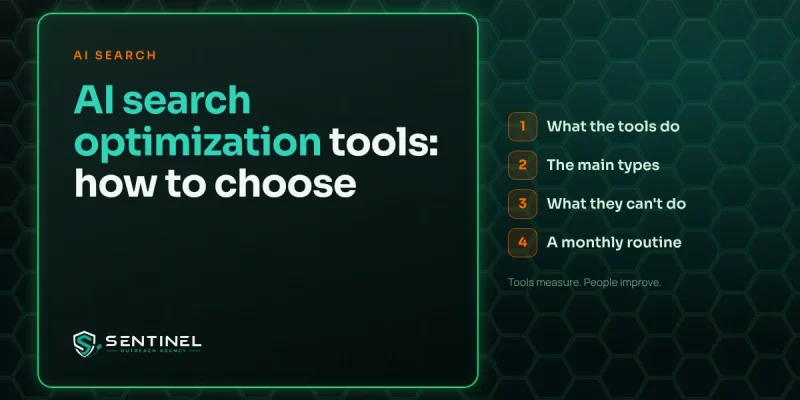
Sentinel InsightsAI search optimization tools:what they track and how to choose.
AI search optimization tools compared by type: visibility trackers, citation maps and technical checks. What they measure, what they miss, how to choose.
AI search optimization tools are software platforms that show how your brand appears in answers from ChatGPT, Gemini, Perplexity, Claude, Copilot and Google’s AI Overviews. Most of them run a set of buyer questions through those assistants on a schedule, then report whether you were named, how you were described, which competitors appeared and which sources the answers cited.
They’re useful, and they’re also easy to over-trust. A tool can tell you where you stand and which publications shape the answers in your category. It can’t earn you a place in those publications. This guide covers the main types of tool, the names you’ll come across, how to choose one and how to turn the data into action.
What AI search optimization tools actually do
Strip away the dashboards and most tools do three jobs. They ask AI assistants a fixed list of questions, they record the answers and citations, and they compare results over time and against competitors.
Some add extra layers: checks on whether AI crawlers can reach your site, sentiment scoring on how you’re described, suggestions for content gaps, or alerts when a new source starts appearing in answers. The core value is still the same. You get a repeatable view of something that’s hard to see by hand, because answers change from one run to the next and from one user to another.
The main types of tool
It helps to sort tools by the question they answer before you compare brands. Many teams end up using two types together.
| Tool type | Question it answers | What to look for |
|---|---|---|
| Visibility trackers | Are we named in AI answers, and how often compared with competitors? | Which assistants are covered, how prompts are chosen, how often they run |
| Citation and source mapping | Which pages and publications do assistants cite in our category? | Domain and URL level detail, export options, trend history |
| Technical checkers | Can AI crawlers reach and read our site? | robots.txt and firewall checks, structured data validation, page rendering |
| Content analysis | Do our pages answer the questions buyers ask? | Question mapping, gap reports, clear reasoning behind suggestions |
| Media monitoring | Where is our brand mentioned across press, social and forums? | Coverage of trade press and podcasts, sentiment, alert speed |
The last category isn’t sold as an AI tool, but it matters. Assistants build answers from what the web says about you, so knowing where you’re mentioned is half the picture. Our guide to tracking brand mentions in AI assistants explains how the two fit together.
AI visibility tools you’ll come across
The market moves quickly, and new platforms appear every few months. A roundup by marketing consultant Lilach Bullock, published in September 2026, describes the following tools among others. We haven’t listed prices, because they change often and depend on the number of prompts and brands you track.
- Otterly.AI tracks brand mentions and cited domains across ChatGPT, Google AI Overviews and AI Mode, Perplexity, Gemini and Copilot, and includes a GEO audit with crawlability checks.
- Peec AI tracks brand visibility, cited sources and competitor appearances across engines such as ChatGPT, Perplexity and AI Overviews.
- Semrush AI Visibility Toolkit reports on brand representation in AI Overviews, AI Mode, ChatGPT, Perplexity and Gemini, with share of voice and sentiment.
- Ahrefs Brand Radar tracks mentions and citations across AI Overviews, AI Mode, ChatGPT, Perplexity, Copilot and Gemini using a large prompt database.
- ZipTie focuses on AI Overviews, ChatGPT and Perplexity, based on what real users see.
- LLMrefs, Rankscale and Scrunch, along with enterprise platforms in the same roundup, cover similar ground with different emphases, from keyword-led tracking to serving an AI-friendly version of your site to AI agents.
If you already pay for Semrush or Ahrefs, start with their AI features before adding another subscription. If AI search is a serious channel for you, a dedicated tracker usually gives more control over prompts and reporting.
What the tools can’t do for you
Every tool in this category measures. None of them changes what assistants say on its own. That gap catches out a lot of teams, who buy a tracker, watch a flat line for three months and conclude AI search doesn’t work for them.
- They can’t earn coverage. Muck Rack’s Generative Pulse research from May 2026 found earned media made up 84% of AI citations in the more than 25 million links it analysed. Moving the numbers usually means getting into those sources.
- Prompts are a sample. Tools ask the questions you or they choose. Real buyers phrase things differently, so a good score on a narrow prompt list can mislead.
- Answers vary by run. The same question can produce different answers an hour apart. Treat single results as noise and look at trends across many questions.
- Suggestions aren’t strategy. Automated content tips can help with on-site gaps, but they rarely tell you which journalist, podcast or trade title would change the answer.
A tracker shows you the scoreboard. The points are scored in the publications assistants read.
How to choose AI search optimization tools
Pick the tool after you’ve decided what you need to learn. These questions narrow the field fast:
- Which assistants matter to your buyers? A B2B software buyer may lean on ChatGPT and Perplexity. A consumer brand may care most about Google’s AI Overviews.
- Can you write your own prompts? You want questions in your buyers’ language, plus the option to add suggested ones.
- Does it show sources at URL level? Knowing that a specific trade article keeps getting cited is far more useful than a domain name.
- How are competitors handled? Look for side-by-side share of answers and the sources that favour each competitor.
- Can you export the data? You’ll want to combine it with coverage logs, analytics and sales notes.
- Does the cost scale sensibly? Many tools price by prompts or brands tracked. Start small and expand once the reports prove useful.
A simple monthly routine
Tools earn their keep when someone acts on what they show. A workable monthly rhythm for a small team looks like this:
- Week one: review share of answers and accuracy across your question set, and note any wrong or outdated descriptions.
- Week two: pull the most cited sources in your category and sort them into publications you could pitch, pages you could correct and reviews you could encourage.
- Week three: act. Pitch expert commentary, update your own pages, fix directory listings and ask publishers to correct errors.
- Week four: log what changed, compare with referral traffic from AI assistants in your analytics, and adjust next month’s targets.
That routine is mostly brand building and Digital PR work with better measurement attached. The tool tells you where to aim. People still have to do the pitching.
Tools, an agency or both
Plenty of in-house teams run a tracker themselves and do well. An agency makes sense when you need the outreach that changes the answers, or when nobody has the hours to turn reports into pitches every month.
Sentinel’s AI search visibility service starts with a one-off AI Visibility Audit at $2,500, which maps your buyers’ questions, the answers four assistants give and the sources behind them. The ongoing AI Visibility Programme runs at $4,500 a month and pairs that measurement with earned coverage in the sources assistants cite. Full details are on our pricing page. We don’t promise AI mentions, because no one can, but you’ll see every answer and every source we track.
Questions readers ask
What is the best AI search optimization tool?
There isn't one best tool for everyone. Choose based on which assistants your buyers use, whether you can write your own prompts and how much source detail you need.
Are free AI visibility checks enough?
Manual checks in each assistant are a fine starting point. Once you track more than a handful of questions or competitors, a paid tool saves time and keeps results consistent.
Do AI search optimization tools improve rankings in AI answers?
No. They measure where you appear and which sources shape answers. Changing those answers usually takes earned coverage, accurate listings and clearer pages.
How often should I check AI visibility?
Monthly reviews suit most brands. Weekly checks make sense around launches, rebrands or reputation issues, when answers can shift quickly.
Want to know what AI assistants say about you?
Our audit maps your buyers' questions, the answers they get and the sources behind them.