Sentinel InsightsWhat is AI visibility,and why does it matter now?
What is AI visibility? How often and how well AI assistants name your brand, what shapes it, how to measure it, and the steps that tend to move it.
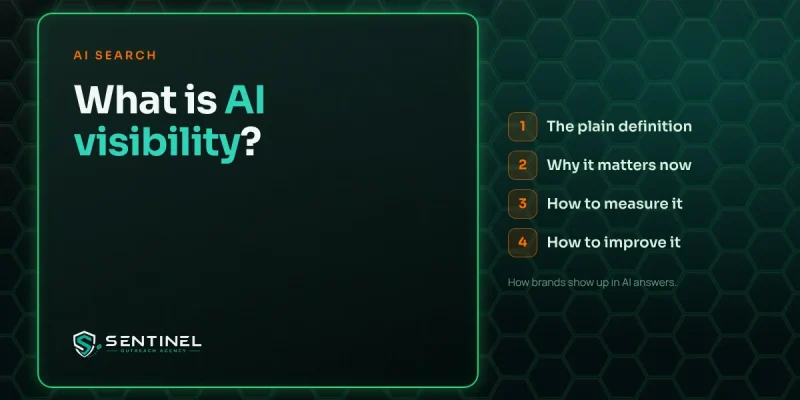
AI visibility is how often, and how accurately, AI assistants such as ChatGPT, Gemini, Perplexity, Claude and Copilot mention your brand when people ask questions you’d want to be part of the answer to. A brand with strong AI visibility gets named when a buyer asks which providers to consider, gets described correctly when someone asks what it does, and gets cited from sources it would be happy to be judged by.
AI visibility matters because more research now starts in a chat window. A buyer who asks an assistant for a shortlist may never see a page of search results, so the assistant’s answer becomes the first impression. You can’t buy a place in that answer directly. You can shape the sources it draws on.
AI visibility in plain terms
Think of AI visibility as three questions you can ask about any assistant:
- Presence. When someone asks about your category, does the assistant name you at all?
- Accuracy. When it describes you, are the facts right: what you sell, who you serve, where you operate, what you cost?
- Sources. Which pages does it cite or lean on, and are they ones you trust, such as respected press, your own site and fair reviews?
A brand can score well on one and badly on another. Plenty of companies get mentioned often but described with old pricing or a product they retired two years ago. Others are described perfectly when asked by name, yet never appear when a buyer asks for options. Good AI visibility means all three are in decent shape.
Why AI visibility matters now
In February 2024, Gartner predicted that traditional search engine volume would drop 25% by 2026 as people turn to AI chatbots and other virtual agents. Whatever the exact figure turns out to be, the direction is clear in how people work: they ask an assistant to compare tools, summarise a market or explain who does what, and they act on the answer.
That changes where reputation gets decided. In classic search, a buyer saw ten links and judged for themselves. In an AI answer, the assistant has already done some of the judging, picked a handful of names and framed each one. If you’re missing from that shortlist, you’re missing from the buyer’s first look at the market.
What shapes how AI assistants see your brand
Assistants build answers from what they learned in training and, increasingly, from live web searches. Nobody outside these companies knows the exact weighting, and it changes often. Still, a few sources clearly matter.
| Source | Why it counts | What you can do |
|---|---|---|
| Earned press and trade coverage | Independent outlets are a common source for category and company answers | Earn coverage with real news, data and expert commentary |
| Your own website | Assistants read it for basic facts about you | Keep services, prices, locations and leadership clear and current |
| Review and comparison sites | Shortlist questions often draw on roundups and reviews | Make sure your listings are complete and accurate |
| Forums and communities | Real user discussions shape how products are described | Answer questions openly from named accounts |
| Structured facts | Consistent names, descriptions and schema reduce confusion | Use the same company facts everywhere you appear |
| Podcasts and interviews | Transcripts and show notes add expert context | Get spokespeople booked on shows your buyers trust |
Earned coverage tends to do the heavy lifting, because it is the source you control least and assistants seem to trust most. Our guide to generative engine optimization explains where PR fits in that picture.
How to measure AI visibility
There’s no single official score. Tools now sell AI visibility dashboards, and they can help, but you can get a clear first read by hand in an afternoon.
- Write a question set. List 20 to 50 questions a real buyer might ask, from “what does this company do” to “which providers should I consider for this problem”.
- Pick your assistants. Use the ones your buyers use. For most US companies that means ChatGPT, Gemini, Perplexity and Copilot at a minimum.
- Ask the same way each time. Use a fresh chat with no history so earlier questions don’t colour the answers.
- Record four things. Whether you were named, where you appeared in the list, whether the description was accurate, and which sources were cited.
- Note competitors. Track who shows up when you don’t. That tells you which sources are winning the answer.
- Repeat monthly. AI answers vary from one run to the next, so the trend over several months matters more than any single result.
At the end you’ll have a simple share of answers across your question set, a list of factual errors to fix and a map of the sources that assistants keep using. That last part is the most useful, because it tells you where effort will count.
How to improve AI visibility
Improving AI visibility is mostly patient work on the sources assistants already rely on. The order below works for most brands.
Fix your own facts first
Make sure your website says plainly what you do, who you serve, where you work and what you charge, if you publish prices. Use the same company description on your social profiles, directory listings and review sites. Inconsistent facts are a common reason assistants get a brand wrong.
Earn coverage in the sources that keep coming up
Your measurement map shows which publications, roundups and communities assistants cite in your category. Those become your target list for media relations, expert commentary and data stories. This is where digital PR and AI visibility overlap almost completely.
Answer the questions buyers actually ask
Publish clear, direct pages and articles that answer the questions in your set. Lead with a one-sentence answer, then give the detail. Assistants find it easier to quote a page that states the answer plainly.
Show up where buyers compare notes
Assistants often lean on forum threads, community answers and podcast transcripts when they describe how a product works in practice. Have named people from your team answer questions openly in the communities your buyers use, and get your spokespeople onto the shows they listen to. Keep it helpful and honest. Thinly disguised sales posts get ignored by people and tend to read badly when an assistant quotes them back.
Correct errors at the source
If an assistant repeats a wrong fact, find where it came from. It’s usually an old article, a stale directory listing or a review site profile. Ask the publisher to update it, and fix anything you control yourself.
What AI visibility work can and can’t do
No one can promise that an assistant will name you, rank you first or describe you a certain way. The companies behind these tools change their models and their search partners often, and answers vary between users and between runs. Anyone selling guaranteed AI mentions is selling something they don’t control.
What good work can do is improve the odds. Clean facts, strong earned coverage and useful content give assistants better material to draw on, and those same assets help with classic search, sales conversations and reputation. If AI visibility work stopped mattering tomorrow, the coverage and content would still be worth having.
If you want a clear picture of where you stand, our AI search visibility service starts with an audit of the questions your buyers ask, the assistants they use and the sources behind each answer. The AI Visibility Audit is $2,500 one-off, and the ongoing programme is listed on our pricing page.
Questions readers ask
What is AI visibility?
AI visibility is how often and how accurately AI assistants such as ChatGPT, Gemini, Perplexity and Copilot mention your brand when people ask questions in your category.
Is AI visibility the same as generative engine optimization?
They're closely linked. AI visibility is the outcome you measure, and generative engine optimization is the work done to improve it, from fixing your own facts to earning coverage in the sources assistants use.
How do you measure AI visibility?
Ask a fixed set of buyer questions in the main assistants each month, then record whether you were named, how you were described and which sources were cited.
Can an agency guarantee my brand appears in ChatGPT?
No. AI companies decide how their assistants answer, and answers vary between runs. Good work improves the sources assistants draw on, which improves the odds without guaranteeing a mention.
Find out what AI assistants say about you
Our audit maps your buyers' questions, the answers they get and the sources behind them.