Sentinel InsightsAI visibility score:what it really measures
What an AI visibility score measures, how tools calculate it, where it misleads, and how to build a simple score of your own from real buyer questions.
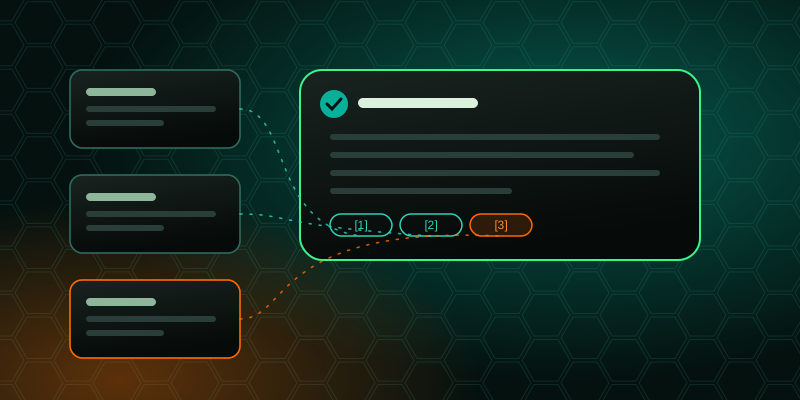
An AI visibility score is a number that summarises how often, and how well, AI assistants mention your brand when people ask questions about your category. Most tools build it by running a fixed set of prompts through assistants such as ChatGPT, Gemini, Perplexity and Google’s AI Overviews, then counting how many answers name you, where you appear and whether the description is accurate.
The score is useful as a trend line and weak as a verdict. Two tools can give the same brand very different numbers, because each one picks its own prompts, assistants and weighting. Treat your AI visibility score as a way to see direction over time, and read the answers behind it before you act on it.
What an AI visibility score measures
Every scoring method starts with the same raw material: a list of questions and the answers assistants give to them. The differences come from what gets counted. Most scores combine some mix of these signals:
- Mention rate. The share of answers that name your brand at all. This is the core of almost every score.
- Position. Whether you’re the first brand named, buried in a list of ten, or mentioned only as an aside.
- Accuracy. Whether the assistant gets your product, pricing model, location and audience right.
- Sentiment. Whether the wording is neutral, positive or critical.
- Citations. Whether the answer links to your site or to coverage about you, and which sources it relies on.
- Share of voice. How your mention rate compares with named competitors on the same prompts.
If you want the background on the wider idea first, our guide to what AI visibility is covers the definition and why it matters.
Why brands have started tracking it
Buyers are asking assistants questions they used to type into a search box. Gartner predicted in February 2024 that traditional search engine volume would drop 25% by 2026 as people turn to AI chatbots and other virtual agents. Whether or not that exact figure holds, the direction has made marketing leads ask a new question: when someone asks an assistant about our category, do we come up?
A score gives that question a number you can put in a monthly report. It also gives you a baseline, so you can tell whether press coverage, new pages or fixes to your profiles are changing anything. Without some form of measurement, AI search becomes a guessing game.
How an AI visibility score is calculated
There’s no industry standard, so it pays to know what sits behind the number you’re looking at. A typical calculation works like this:
- A set of prompts is chosen, often between 20 and a few hundred, grouped by topic or buying stage.
- Each prompt runs in several assistants, sometimes more than once, because answers vary from run to run.
- Each answer is scored for mention, position, accuracy and citations.
- The results are weighted and rolled up into a single figure, often out of 100.
Here’s a simplified, hypothetical version for a payroll software company, with 40 prompts run in four assistants:
| Signal | Hypothetical result | What it tells you |
|---|---|---|
| Mention rate | Named in 52 of 160 answers | You’re visible in about a third of answers |
| Position | First brand named in 9 answers | You’re rarely the default recommendation |
| Accuracy | Pricing wrong in 14 answers | Your published pricing isn’t reaching assistants |
| Citations | Own site cited 6 times, trade press 2 times | Few independent sources talk about you |
A single score would hide most of that. The table tells you what to fix: the pricing errors point to an on-site problem, and the low citation count points to a coverage problem.
What the score can’t tell you
An AI visibility score is a sample, and samples have limits. Keep these in mind before you report it upward:
- Prompt choice drives the result. Change the list of questions and the score changes, even if nothing about your brand did.
- Answers vary. The same prompt can name you in one run and skip you in the next, so single checks are noisy.
- Tools disagree. Each vendor weights signals differently, so scores from two tools aren’t comparable.
- It isn’t revenue. A higher score doesn’t prove more buyers found you through an assistant. Pair it with what your sales team hears and what your analytics shows from AI referrals.
- Nobody controls it. No agency or tool can guarantee a score or a mention, because no one controls what an assistant says.
How to build your own AI visibility score
You don’t need software to start. A spreadsheet and two hours a month will give you a usable score.
Pick the prompts
Write 30 to 50 questions your buyers really ask. Mix category questions such as “best expense software for small agencies”, comparison questions that name a competitor, and problem questions such as “how do I stop staff losing receipts”. Keep the list fixed so month-to-month comparisons mean something.
Run and record
Run each prompt in three or four assistants. Record whether you’re named, your position, any factual errors and the sources cited. Our guide on tracking brand mentions in AI assistants walks through a simple logging set-up.
Score it simply
Give one point for a mention, one more for appearing in the top three, and one more for an accurate description. Divide the total by the maximum possible and multiply by 100. It’s crude, and that’s fine. A transparent score you understand beats a polished one you can’t explain.
How to report it to your team
A number on its own invites the wrong conversation. Leadership will ask why it dropped four points, and the honest answer is often that the assistants changed while your brand stayed the same. Report the score with context so it leads to decisions:
- Show the trend over at least three months, with the prompt list unchanged.
- Split the score by topic or buying stage, so you can see where you’re strong and where you’re missing.
- List the three most common factual errors and who owns fixing each one.
- Name the sources assistants cite most often in your category, and mark which ones mention you.
- Note the work done that month, such as new coverage or page updates, so changes can be linked to causes.
That last point matters most. A score that sits next to a log of what you did becomes a planning tool. A score on its own is just a number to worry about.
How to raise your score
The score moves when the sources assistants read change. Most of the gains come from three kinds of work:
- Fix your own facts. Make sure your About page, service pages, pricing and profiles say the same thing in plain sentences.
- Earn independent coverage. Trade press, expert commentary, podcasts and inclusion in the roundups assistants already cite. This is where digital PR does most of the heavy lifting.
- Publish direct answers. Definition, comparison and pricing pages that answer a buyer’s question in the first two sentences.
Paid placements can help you reach an audience, but they should always be labelled as paid. Building a recognisable brand over time, through consistent brand building, also gives assistants more to draw on.
If you’d like an outside view, our AI Visibility Audit is a one-off $2,500 project that tests buyer questions across the main assistants and maps the sources behind each answer, and the AI Visibility Programme runs the ongoing work from $4,500 a month. You can compare both on our pricing page.
See how the audit and programme work on our AI search visibility page.
Questions readers ask
What is a good AI visibility score?
There's no universal benchmark, because every tool uses its own prompts and weighting. Compare your score with your own baseline and with named competitors measured the same way.
Why do different tools give different AI visibility scores?
Each tool picks different prompts, assistants and weightings. Scores from two vendors aren't comparable, so pick one method and stick with it.
How often should I check my AI visibility score?
Monthly is enough for most brands. Answers vary from run to run, so trends across several months matter more than any single check.
Can an agency guarantee a higher AI visibility score?
No. Nobody controls what AI assistants say. Good work on your facts, coverage and content improves the odds, but no one can guarantee a score or a mention.
Get a clear AI visibility baseline
We'll test the questions your buyers ask and show you the sources behind every answer.